For industrial low-voltage distribution stations and factory power control rooms, choosing between a motorized or manual switchgear drawer directly shapes daily operation efficiency, on-site safety management and long-term maintenance costs, and a practical Hand Operated Mechanism lays a solid foundation for stable manual cabinet control in harsh working environments. Most facility managers search this comparison to settle on cost-effective, site-matching hardware that fits their team’s operational habits, budget limits and local power grid management standards. Based on industry data from the International Electrotechnical Commission (IEC), nearly 42% of small and medium-sized industrial power renovation projects prioritize flexible drawer operation modes to cut unnecessary electric energy consumption and reduce complex electrical accessory failures in daily use.
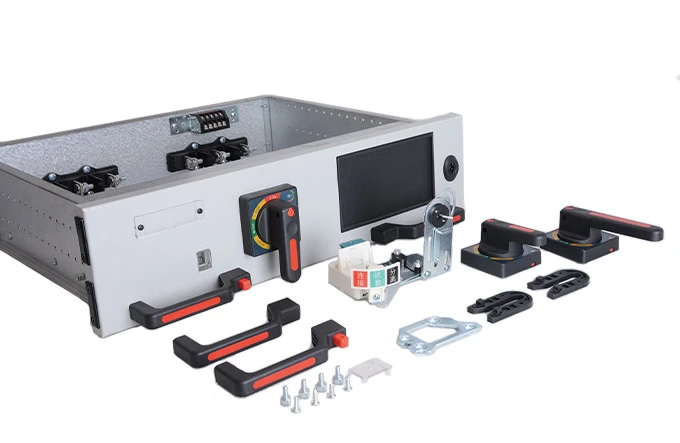
In modern power distribution systems, low-voltage withdrawable switchgear cabinet acts as the core carrier for circuit control, protection and isolation, and the drawer unit is the most frequently operated component throughout the equipment service life. Every push-pull action, locking adjustment and circuit isolation step relies on the built-in driving structure, which splits into two mainstream types across the global market: fully motor-driven automatic drawers and manually controlled portable drawer units from brands like XHONELE. Many procurement engineers and electrical contractors overlook actual on-site conditions when selecting models, blindly pursuing full automation or excessive cost savings, and eventually face stuck drawers, frequent motor damage or hidden safety risks during emergency power cuts.
To truly distinguish the practical value of the two drawer types, it is necessary to start with their internal transmission logic and structural design differences.
Motorized switchgear drawer relies on built-in micro drive motors, reduction gear sets and intelligent control modules to realize remote or local one-key opening, closing and locking actions. It matches with intelligent power distribution control system to achieve linkage with upper computer monitoring equipment, suitable for unattended distribution rooms and large industrial park centralized power management scenarios. The whole operation process requires almost no manual force, and the travel stroke and locking force are controlled by program settings, with high action accuracy and unified operation standards.
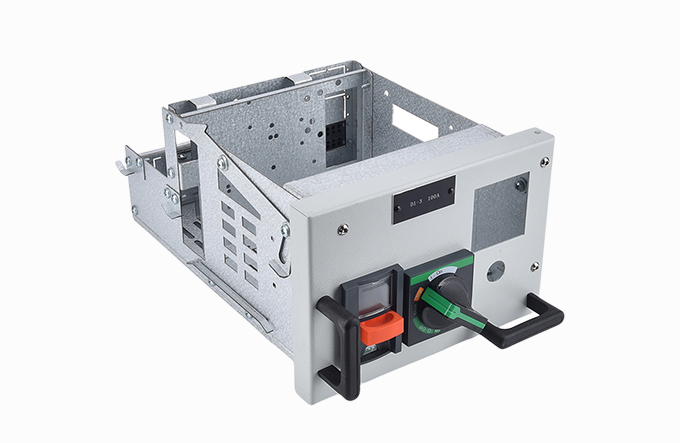
Different from automatic driving design, manual switchgear drawer adopts pure mechanical transmission components, including gears, locking latches, connecting rods and positioning fixtures, and all drawer switching and isolation operations are completed through human-assisted pushing, pulling and rotating adjustment. This structural design abandons electronic power components, so it is not affected by voltage fluctuation, signal interference or circuit failure, and retains extremely high reliability in complex industrial environments with dust, humidity or frequent power fluctuations.
Safety is always the top consideration for electrical equipment configuration, especially for key components involved in circuit breaking and isolation.
Motorized drawer products perform well in conventional daily operation; standardized electric drive avoids violent manual pulling and irregular operation. Yet their obvious weaknesses emerge in extreme emergencies. Once sudden power failure, control circuit burnout or motor short circuit occurs, the electric driving system will completely fail, and on-site staff need to spend extra time with professional tools to unlock the equipment forcibly, which delays emergency power outage maintenance and fault handling progress.
By contrast, manual drawer units show unique advantages in emergency response. Without relying on any power supply or electronic control signals, staff can complete isolation and closing operations through standardized mechanical steps at any time. For chemical plants, manufacturing workshops and remote regional distribution boxes with unstable power supply, this anti-risk capability effectively avoids secondary accidents caused by equipment failure.
Total lifecycle cost is a key factor that industrial buyers cannot ignore, covering procurement budget, regular maintenance, accessory replacement and later failure loss.
The overall procurement price of motorized switchgear drawers is 30% to 50% higher than ordinary manual models, according to the 2025 low-voltage electrical equipment cost report released by Global Electrical Equipment Association. Besides high initial investment, they contain a large number of precision electronic parts and wearing transmission parts. Daily dust accumulation, damp corrosion and frequent start-stop will accelerate motor aging and circuit module damage, requiring quarterly professional detection and regular replacement of wearing parts, which raises after-operation management costs invisibly.
Manual drawer structures feature fewer precision vulnerable parts and simpler overall assembly logic. Daily maintenance only needs regular surface dust cleaning and mechanical latch lubrication, with low technical threshold and no need for professional electrical maintenance personnel to follow up for a long time. For small factories, municipal supporting distribution stations and decentralized small power distribution points, this low-maintenance feature can greatly reduce later operation burden.
No single product can adapt to all power distribution scenarios, and reasonable selection must be combined with on-site staffing, management mode and environmental conditions.
Motorized switchgear drawers are more suitable for large-scale data centers, urban comprehensive power distribution hubs, large industrial parks and fully automated intelligent factory projects. These scenarios are equipped with stable power supply, professional intelligent monitoring system and special operation and maintenance teams, and the efficient linkage and remote control advantages of electric drawers can be fully exerted to improve the overall intelligent management level of power distribution.
On the other side, manual operation type drawer units are widely recognized in scattered working conditions: field construction temporary power distribution, mining area harsh environment power cabinets, rural supporting power facilities and small workshop independent distribution rooms. XHONELE has long focused on customized optimization for such segmented scenarios, supporting non-standard size adjustment, anti-corrosion surface treatment and anti-misoperation locking structure customization, to meet the differentiated demands of special working conditions.
After sorting out the advantages, defects and applicable boundaries of the two drawer types, it is not difficult to find that full automation is not equal to high practicability, and low-cost manual configuration is not the only cost-saving choice.
For large unattended distribution rooms and intelligent power distribution projects with sufficient budget and complete supporting facilities, motorized switchgear drawers are worthy of priority, as they optimize operation efficiency and unify standardized management. For most traditional manufacturing industries, regional supporting power facilities and projects with limited budget and unstable on-site power supply, a stable manual matching design is more down-to-earth and reliable.
In actual engineering configuration, many medium-sized enterprises begin to adopt a mixed layout mode: key core cabinet groups use motorized drawers to ensure daily efficient management, while peripheral auxiliary distribution cabinets adopt a mature Hand Operated Mechanism to cope with sudden power failure and equipment failure risks. This collocation balances intelligent demand and safety redundancy, and also controls overall project investment within a reasonable range. Facing the increasingly complex industrial power consumption environment, this diversified combined configuration has gradually become a mainstream optimization scheme in the industry in recent years.
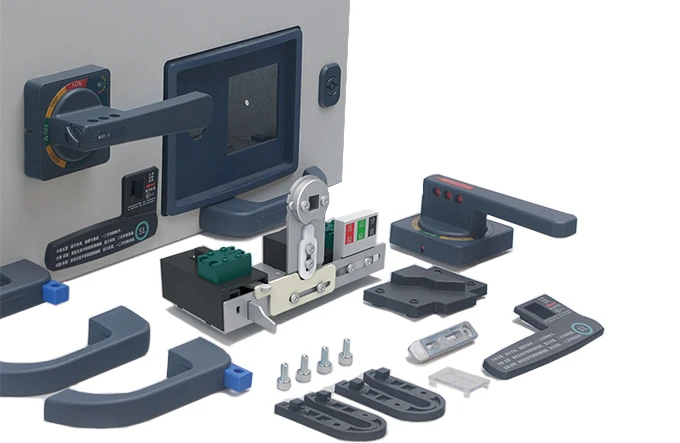
The gap between motorized and hand controlled switchgear drawers lies not in product grade, but in scenario matching degree. Motorized units win in intelligent linkage and labor-saving operation, while manual drawer products take the lead in environmental adaptability, emergency stability and low lifecycle maintenance cost. Before formal procurement and transformation, electrical engineers need to fully evaluate on-site power supply conditions, team operation capabilities, later maintenance conditions and risk response demands, instead of blindly following automated trends.
As a professional brand focusing on low-voltage switchgear supporting components, XHONELE keeps optimizing both electric transmission structures and mechanical operation designs, covering standardized products and personalized customized services, to help every industrial user find the most suitable switchgear drawer solution. For users who focus on stability and cost control in complex working conditions, rational use of reliable manual control structures can effectively reduce equipment failure rates and create more stable basic guarantees for industrial power consumption.
pubdate: 2025/10/09 2026/07/15
How to Organize Spare Parts for LV Cabinetspubdate: 2025/10/09 2026/07/07
5 Daily Checks for Drawer Switchgear – A Maintenance Technician’s Guidepubdate: 2025/10/09 2026/06/30
Solve Loose Plug‑in Contact Connection